
A HALO Framework for Higher Education
You Can’t Spell ‘Anxiety’ Without AI
Every day, we read something new about the impact of AI on higher education. Much of this focuses on which skills are automatable, which jobs are replaceable, and—looking upstream—which academic programs students should avoid. Gallup reported that 42% of bachelor’s degree students and 56% of associate degree students have considered changing their major because of AI’s impact on their careers. Sixteen percent already have.
These concerns are real and well-founded. They are also incomplete.
Advantage: Human Work
Rather than operating from a ‘dread mindset’ about which fields will decline, students and institutions need a way to identify the fields that become more valuable in an AI-saturated economy – fields that rely on human judgment, trust, physical presence, ethical discernment, relationships, and applied expertise.
Finance has a term for companies with a low risk of decline in an AI era: Heavy Assets, Light Obsolescence (HALO). Higher education needs a similar framework to spotlight academic programs that combine ongoing demand with work that remains enduringly human.
To make this idea more practical, we developed a framework institutions can use to evaluate program durability:
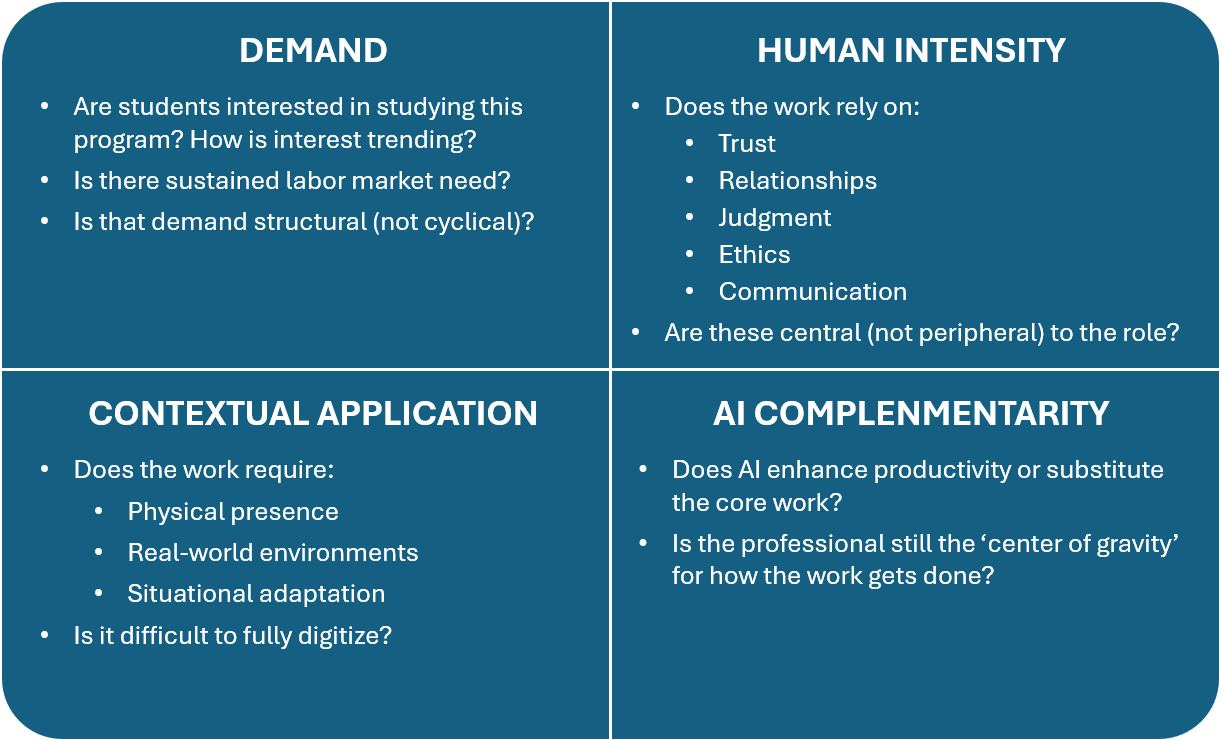
Programs that score well across these dimensions maintain relevance and viability, even as conditions around them evolve.
What is a HALO Program?
Certain types of programs consistently fit this framework:
Care-Intensive
Examples: Nursing, Allied Health, Occupational Therapy, Physical Therapy, Social Work, Counseling
Drivers of Durability: high human contact, trust, ethics, embodied care, regulated environments
Human Development and Learning
Examples: Education, Special Education, Speech-Language Pathology, School Counseling
Drivers of Durability: high human contact, AI complementarity, trust, physical presence, regulated environments
Applied Technical Fields in Physical Environments
Examples: Engineering, Advanced Manufacturing, Construction Management, some Environmental and Agricultural areas
Drivers of Durability: physical environments, real-world constraints, safety, site-specific judgment, physical systems
Laboratory and Physical Sciences
Examples: Biology, Biochemistry, Chemistry, Physics, Geology
Drivers of Durability: true innovation, AI-enabled methods, study design, human judgment
Skilled Trades
Examples: Automotive, Electrical, HVAC, Plumbing, Welding
Drivers of Durability: safety, embodied presence, physical environments
Incomplete though it may be, this list illustrates the key attributes of durability. These programs are human-centered, applied and ‘real-world,’ and frequently rely on judgment, context, ethics, and relationships.
It is simultaneously important to know that HALO programs are not “AI proof” in the sense that they will not be impacted by the technology. They will be. The difference is that the impact will be defined more by augmentation than replacement.
The Angel’s in the Details
The future of academic programs is not binary (survive or perish). Like occupations, academic programs sit somewhere on a spectrum between total replacement and zero impact.
Even within a given field, a program can be oriented in a way that increases or decreases its AI resistance.
Business Analytics programs that focus on calculation and descriptive statistics appear less sustainable than programs that emphasize leadership, decision-making, and organizational behavior.
Coding-intensive Computer Science programs feel more exposed than those that focus on systems design and human-centered computing.
HALO programs are not all or nothing – the same field can be more or less sustainable depending on how it is practiced.
Implications
Now is an important time for institutional leaders to review their offerings, think hard about long-term viability, and evaluate how well current programs can realistically prepare students for successful careers. Important questions:
Where does our institution already have “HALO program” strengths?
How do we include AI exposure in our program review process?
How can marketing emphasize human-centered outcomes and applied skills?
How are we (or how could we) integrating AI into programs in ways that enhance (not replace) the human role?
Are there institution-aligned programs we should be offering to meet the moment?
On this last point, it is essential to clarify that the program implications for each institution will be different. Not every institution should offer Nursing. Instead, the objective is to identify programs that meet the criteria of the framework and are aligned with your institution’s identity and strengths. This is where real, enduring gains are made.
Looking Ahead
The intent of this framework is not to define a fixed set of “AI-proof” programs. It is to offer a useful way of evaluating them. The real shift underway is not simply which programs grow or decline – it is how value is created. As routine cognitive work becomes easier to replicate, the work that remains valuable will be defined by judgment, context, and human interaction.
For colleges and universities, that changes the question. It is no longer just, “Where is demand today?” but “What makes that demand sustainable over time?”