
The Founder Generation
In the 2010 film The Social Network, the president of Harvard rolls his eyes at young people’s obsession with founding companies and bemoans that “Harvard undergraduates believe inventing a job is better than finding a job.”
His insight was not far off the mark. If anything, the instinct has only intensified. Fifty percent of Gen Z adults plan to start a new business in 2026, compared with 44% of Millennials and 31% of Gen X. The Harris Poll found that 57% of Gen Z adults already has some sort of side hustle vs. 21% of Boomers.
We’ve seen this in our own experience interviewing and surveying prospective students. Students increasingly mention a desire to start their own business after graduation, gain foundational entrepreneurial skills, or even compare the value proposition of a degree against not just working but starting their own company. We even hear this reciprocated by businesses – in a recent survey we conducted, business leaders cited a desire for entrepreneurial thinking and an “ownership mindset.”
Why is This Happening?
There are at least four major forces driving heightened interest in entrepreneurship.
First, AI smooths the process to launching a company by giving inexperienced founders medium-level skill across a range of tasks (coding, writing, marketing, etc.). In other words, it’s never been easier to start something new.
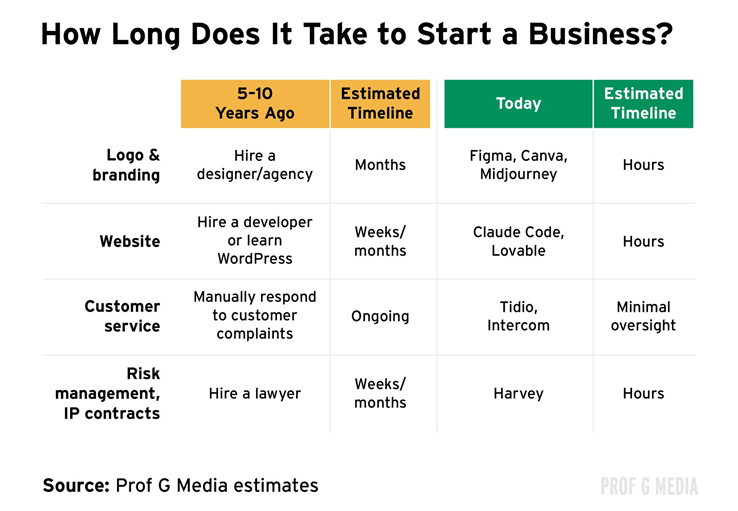
Second, a cooling job market for recent graduates has made traditional employment pathways harder and less attractive. We’ve written before about hiring for new graduates being down 16% in 2025. The outlook for this coming year’s graduates does not look much friendlier. In that environment, starting something new feels less like a leap of faith and more of a comparable alternative to a traditional job.
Third, this generation of current students, recent graduates, and future students has grown up in an era that glorifies business founders in media, markets, and even politics. Whether it’s Elon Musk or “solo-preneurs,” founders seem to be everywhere. Fact: today’s high school Juniors have never known a world without the show Shark Tank.
Bonus Factor: Social media amplifies the perception that launching a business is common and attainable. Viral success stories, influencer growth, and funding announcements create an echo chamber in which startup life looks not just possible but easy.
College as Catalyst
Against this backdrop, how might colleges position themselves as not just conduits to traditional career pathways but also catalysts, and even platforms, for aspiring entrepreneurs?
Expand the definition of “successful outcomes.” Most outcomes storytelling spotlights alumni at recognizable organizations — and rightly so. There is co-branding equity in showcasing a graduate at JP Morgan or NASA. But as student interest shifts, so too should the mix of stories we elevate. Highlighting alumni who have launched their own ventures—whether high-growth startups or sustainable small businesses—signals that the institution does not simply prepare students to be hired, it prepares them to build.
Make entrepreneurship explicit, not an implicit by-product. Many colleges already cultivate the raw ingredients of entrepreneurship: problem-solving, collaboration, resilience, experimentation. The issue isn’t whether those skills are present — it’s whether students recognize them as preparation for launching something of their own. Enrollment and marketing leaders can work with academic partners to articulate this connection more clearly. Where are students building and testing ideas? Where are they managing budgets, leading teams, or iterating on solutions? When those experiences are framed explicitly as entrepreneurial preparation, institutions make their value proposition more relevant to students weighing “college vs. start something now.”
Position the institution as a risk mitigator. The reality remains: half of new businesses fail within five years. AI may lower the barrier to entry, but it does not eliminate market risk, capital constraints, or missteps. Colleges have an opportunity to position themselves not as alternatives to entrepreneurship, but as environments that de-risk it. Access to faculty mentors, alumni networks, experiential learning, and even failure within a lower-stakes setting all meaningfully improve the odds of long-term success. For institutions competing against the “skip college and build” narrative, this framing is powerful: you don’t delay entrepreneurship by enrolling — you improve your probability of succeeding at it.
Adjust inquiry stage messaging. If more students enter the funnel with entrepreneurial ambitions, are we even asking about it? Inquiry forms, campus visit programming, and application essays still heavily assume traditional career pathways. Even simple shifts—spotlighting startup competitions, maker spaces, alumni founders, or interdisciplinary innovation—can signal alignment earlier in the recruitment journey.
Paddling Their Own Canoe
I view this trend towards entrepreneurship positively. There is something inherently hopeful in the desire to start your “own thing.” At a time when unemployment for new graduates is the highest it’s been in a decade (excluding COVID), it is natural for today’s students to wonder if they could forge their own path.
Institutions will resonate with today’s students if they do not dismiss that instinct but rather articulate how their academic experience strengthens, sharpens, and stabilizes students’ entrepreneurial ambition. In a market where “inventing a job” increasingly feels as viable as finding one, higher education’s role may be more balance between directing students toward employment and preparing them to create it.